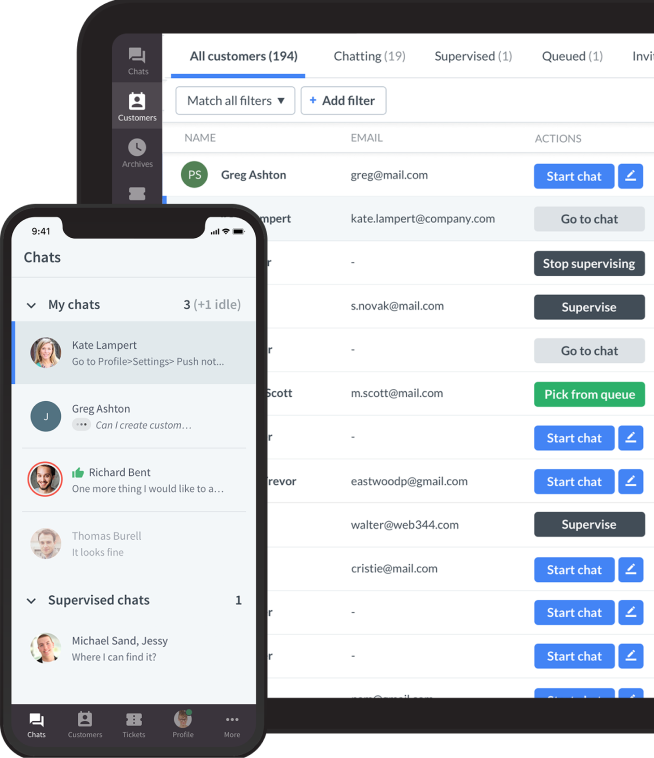


Customer engagement is the ongoing relationship a brand builds with customers across touchpoints such as live chat, email, self-service, social media, and post-purchase support.
But more contact is not automatically better. What matters is whether the interaction is useful, timely, and relevant.
When customers can get an answer while comparing products, solve a problem without repeating themselves, or receive help before they abandon a purchase, they are more likely to buy, return, and recommend the brand. That is what effective customer engagement looks like in practice.
This guide explains the meaning of customer engagement, the five stages of engagement, four common types, practical examples, and the metrics that show whether your approach is working.
What is customer engagement?
Customer engagement embodies the continuous nurturing of interactions between a company and its consumers, transcending mere transactions. It entails the company's deliberate, consistent effort to deliver value at every touchpoint, fostering customer loyalty.
Customer engagement is the two-way relationship between a business and its customers. It is built through the conversations, content, support, and experiences customers have with a brand before, during, and after a purchase. A customer who asks a question in live chat, reads a helpful onboarding email, leaves a review, or returns because a previous issue was resolved quickly is engaging with the business in a different way.
At its best, engagement helps customers make progress: it gives them relevant information when they are deciding, quick help when something goes wrong, and a reason to stay after the first transaction. Over time, those experiences can improve customer satisfaction, retention, and revenue.
Engagement is not the same as attention. A customer opening every email because they are trying to solve an unresolved issue is active, but not necessarily engaged in a positive way. Likewise, a high number of chat conversations can indicate strong purchase intent or signal that basic information is missing from your website. Context determines whether an interaction is healthy.
The most useful definition is therefore practical: customer engagement is the quality of the ongoing exchange between the customer and the business. It asks whether customers can make progress, feel understood, and choose to continue the relationship.
Why do you need a customer engagement strategy?
A customer engagement strategy gives teams a shared plan for how they will support and communicate with customers across the customer journey. Without one, marketing, sales, and support can send disconnected messages, work from different customer histories, or respond too late to be useful.
It also helps distinguish three related ideas:
- Customer experience (CX) is the overall impression people form from every interaction with a brand.
- Customer satisfaction is how customers rate a specific interaction or experience against their expectations.
- Customer engagement is the ongoing, active relationship between the customer and the business.
The three influence one another, but they are not interchangeable. A customer may be satisfied with a single support interaction without becoming a repeat buyer.
Engagement is what keeps the relationship moving forward.
An effective strategy starts with the moments that matter most: questions on a product page, hesitation at checkout, onboarding after a purchase, support requests, renewal decisions, and feedback. It then gives the right team the tools and context to respond well.
Our Ultimate Customer Service Guide covers the service practices that support long-term engagement.
Start with one clear business goal rather than trying to improve every interaction at once. A retailer might focus on reducing checkout abandonment. A SaaS company might prioritize helping new customers reach their first success milestone. A support team might focus on improving resolution quality for its most common issue. The goal shapes which moments to improve, which messages to send, and which metrics to track.
A useful strategy also assigns ownership. Marketing may own educational content and lifecycle communication, sales may own high-intent conversations, and support may own problem resolution and feedback. Customers experience one brand, however, so teams need shared definitions and a way to pass context between them.
What are the five stages of customer engagement?
There is no single customer engagement model that fits every business. Still, a practical way to plan engagement is to map it across five stages: awareness, consideration, conversion, retention, and advocacy.
1. Awareness
At the awareness stage, people are learning that your brand or solution exists. They may have a problem to solve but are not ready to buy yet. They are testing whether you understand it.
Your job is to be useful without being intrusive. Educational content, clear landing pages, reviews, and timely chat greetings can help visitors find what they need and take the next step.
For example, a visitor reading a guide about choosing a product could see a short, targeted chat message offering help with the comparison. LiveChat's targeted messages let teams reach visitors based on their behavior and context.
At this stage, look for signs of interest rather than immediate revenue: relevant page views, guide downloads, newsletter sign-ups, chat starts, and return visits. They show whether potential customers found enough value to continue the relationship.
2. Consideration
During consideration, customers compare options, check pricing, and look for proof that your product will meet their needs. Questions often become more specific: Does it integrate with our stack? Which plan is right? How quickly can we get started?
This is a high-value moment for real-time help. A knowledgeable chat agent can explain a feature, answer an objection, or point a visitor to the most relevant product or resource page. For ecommerce brands, product recommendations and quick answers can make a complicated choice feel simpler. For B2B teams, the same conversation may help a buyer involve the right colleague or build a short internal case for a trial.
Clarity wins here.
Consistency matters here. Pricing information, product descriptions, support answers, and sales messages should not contradict each other. When they do, customers spend more effort validating the information and are more likely to leave without deciding.
3. Conversion
At conversion, customers are ready to purchase, sign up, or book a demo. Small points of friction can still stop them: a discount code fails, shipping is unclear, or they need reassurance before entering payment details.
Offer an easy way to get help without forcing customers to leave the page. Proactive chat on cart and checkout pages can resolve questions while purchase intent is high. Teams using LiveChat for ecommerce can support shoppers in the moment and guide them toward a completed order. The customer should always be able to ignore the message and carry on.
In practice: Wembley Stadium used AI-led chat to pre-qualify incoming leads, reducing qualification time from up to 48 hours to seconds. The company reports that this approach generated more than $1.5 million in additional revenue over eight months.
Do not confuse pressure with engagement. A conversion-stage message should remove a real obstacle, such as uncertainty about a plan, delivery time, return policy, or setup requirement. It should not distract customers who are already able to complete the action on their own.
4. Retention
Engagement does not end once a customer converts. The retention stage is where you help customers get value from what they bought, resolve issues quickly, and feel confident they made the right choice.
Helpful onboarding, self-service content, fast support, and thoughtful follow-ups all matter here. An AI assistant can answer routine questions instantly, while agents handle more complex situations with the right conversation context. LiveChat AI is designed to help teams provide faster support without losing the human handoff when it matters.
Customers should not have to work hard to keep being customers.
Retention work is often about preventing small points of friction from becoming reasons to leave. Review recurring support topics, watch for stalled onboarding, and make key resources easy to find. A short check-in after a customer completes an important action can be more helpful than a long series of generic messages.
5. Advocacy
Advocacy happens when customers are willing to recommend your brand, leave a review, share feedback, or bring others to it. You cannot force advocacy, but you can make it easier by consistently delivering helpful experiences and asking for feedback at the right time.
After a positive support interaction or successful onboarding milestone, invite customers to review their experience, join a referral program, or share a suggestion. Feedback loops also show customers that their input has a real effect on the product or service.
Advocacy is strongest when the request feels earned. Ask for a review after a meaningful success, not immediately after an automated confirmation.
When customers share criticism, acknowledge it and explain what happens next. Both positive and negative feedback can strengthen trust when the response is timely and specific.
Deliver exceptional experience
Use LiveChat reports and analytics to drive your engagement strategies.
Trusted by 36,000+ companies

What are the four types of customer engagement?
Customer engagement can take many forms. One practical framework groups it into four types: emotional, contextual, convenient, and social engagement. Most strong customer engagement strategies combine all four.
The value of this framework is not in labeling every interaction perfectly. It is in checking whether your engagement approach has a healthy balance. A message can be well-timed but still feel impersonal; a loyalty program can create activity but still be hard to use. Looking at engagement from several angles helps teams spot those gaps.
1. Emotional engagement
Emotional engagement is the feeling customers associate with your brand. Trust, confidence, relief, and a sense of being understood can all affect whether they want to return.
For example, a support agent who acknowledges a frustrating issue, takes ownership, and follows up after it is fixed can turn a difficult moment into a reason to stay loyal.
Emotional engagement is especially important when the customer is uncertain, disappointed, or making a high-consideration decision. It is built through clear expectations, honest communication, and a tone that matches the situation rather than through exaggerated friendliness.
2. Contextual engagement
Contextual engagement means responding to what a customer is trying to do right now. It uses the information available in the moment, such as the page they are viewing, the product they bought, or the question they have asked.
For example, instead of showing every visitor the same greeting, an online store can offer sizing help on an apparel page or delivery information on a checkout page.
Context can also include what has already happened. If a customer has an open order issue, the next conversation should begin with that information. If a new customer has not completed setup, the next message should help with the step they are most likely to be stuck on.
3. Convenient engagement
Convenient engagement removes effort. Customers should be able to get help in the channel they prefer, find an answer quickly, and avoid explaining the same issue repeatedly.
Live chat, self-service resources, quick replies, and smart routing all contribute to convenience. The key is not to add channels for the sake of it, but to make each available channel reliable and easy to use.
Convenience is measurable. Look for repeated contacts, long resolution times, abandoned support flows, and the number of times customers are transferred.
The number of channels is rarely the point.
4. Social engagement
Social engagement happens when customers interact with a brand or with one another in public spaces. Comments, reviews, user-generated content, communities, and referrals all fall into this category.
For example, replying constructively to product feedback on social media can show existing and prospective customers that the brand listens and acts on what it hears.
Social engagement also creates a feedback loop for the business. Reviews and community discussions reveal the language customers use, the problems they care about, and the proof they want before buying. Bring those insights back into product pages, support content, and agent training.
Strategies for effective customer engagement
Customer engagement is crucial for businesses to foster loyalty, drive users, and enhance brand reputation. Employing the right strategies to manage customer engagement can significantly impact customer satisfaction and retention.
Here are key strategies for maximizing customer engagement:
1. Proactive communication
Proactive customer communication involves reaching out to users before they initiate contact, either through automated messages or personalized chats. You can use LiveChat to facilitate immediate interactions and convert leads into customers by employing pre-set messages or initiating personalized chats upon visitors' arrival.
Automated messages
Use LiveChat’s canned responses to automate engagement, greet visitors, and offer assistance based on predefined triggers. These messages can be tailored to specific scenarios, such as welcoming new visitors, promoting ongoing promotions, or addressing common inquiries.

Personalized chats
Initiate personalized chats with visitors based on their browsing behavior or previous interactions. By proactively engaging with customers, businesses can provide timely assistance, address concerns, and guide them through purchasing, ultimately improving conversion rates.
2. Multichannel integration
Incorporating multichannel integration allows businesses to extend their customer support efforts across various communication platforms, catering to customers' preferred channels and enhancing accessibility.
The LiveChat integration with platforms like WhatsApp Business, Messenger, and Apple Messages for Business provides seamless communication and better engagement.
WhatsApp Business integration
Enable customers to connect with your business through WhatsApp, a widely used messaging platform. By integrating LiveChat with WhatsApp Business, companies can provide real-time support, answer queries, and extensively build stronger customer relationships on their platform.
Facebook Messenger integration
Integrate LiveChat with Facebook Messenger to engage with customers directly through social media. By offering support via Messenger, businesses can reach a broader audience, leverage rich media features, and provide personalized assistance, driving engagement and increasing customer satisfaction.

Apple Messages for Business integration
Extend customer support to Apple users by integrating LiveChat with Apple Messages for Business. This integration allows businesses to engage with users through iMessage, offering convenient support options and enhancing the overall customer experience for iOS users.
3. Ecommerce integration
Ecommerce integration enhances the shopping experience and drives sales through LiveChat.
By integrating LiveChat with leading ecommerce platforms, businesses can offer in-chat product recommendations, provide real-time assistance, and streamline purchasing, ultimately increasing conversions and revenue.
Product recommendations
Leverage LiveChat's integration with ecommerce platforms to offer personalized product recommendations during chat interactions. By analyzing customer preferences and browsing history, businesses can suggest relevant products, upsell or cross-sell items, and enhance the overall user experience.
Real-time assistance
Provide real-time assistance to customers during the purchasing process, addressing any concerns. By offering immediate support through LiveChat, businesses can alleviate doubts, overcome objections, and guide customers toward completing their transactions, resulting in higher conversion rates and reduced cart abandonment.
4. Automation
Automation is crucial in streamlining customer interactions and improving response times, enhancing efficiency and customer satisfaction. LiveChat offers AI-powered automation features such as AI Assist and Chat Summary, which enable businesses to automate repetitive tasks, resolve inquiries more efficiently, and deliver a seamless customer experience.
Use AI to handle routine questions faster
AI can help teams answer common questions, summarize conversations, and direct customers to the next best step. Used well, it reduces waiting time and frees human agents to focus on sensitive, complex, or high-value conversations.
Set clear escalation paths and keep reviewing automated answers. Speed matters, but accuracy and empathy matter too, especially when a customer has a billing problem, a complaint, or a decision to make.
Chat Summary
Enhance efficiency and productivity with Chat Summary, a feature that provides a comprehensive overview of chat interactions. By automatically summarizing chat conversations, including critical points, customer inquiries, and actions taken, businesses can quickly review past interactions, identify trends, and prioritize follow-up tasks, improving responsiveness and customer satisfaction.
5. Data-driven insights
Harnessing data-driven insights is essential for optimizing customer engagement strategies and making informed business decisions. LiveChat's reporting capabilities help measure the right customer service metrics, allowing businesses to derive actionable insights, track performance, and continuously improve customer engagement.

Reporting capabilities
Utilize LiveChat's reporting capabilities to track key metrics such as chat volume, response times, customer satisfaction scores, and conversion rates. By analyzing these metrics, businesses can identify trends, monitor user performance, and make data-driven adjustments to improve efficiency and effectiveness.
Actionable insights
Derive actionable insights from chat transcripts, customer feedback, and performance metrics to identify improvement areas and innovation opportunities. By understanding customer preferences, pain points, and behavior patterns, businesses can tailor their engagement strategies, refine their messaging, and deliver more personalized experiences.
Effective customer engagement is a continuous process that requires proactive communication, multichannel integration, ecommerce support, automation, and data-driven insights. By implementing these strategies and leveraging LiveChat's capabilities, businesses can enhance customer effort score and user satisfaction, drive sales, and build lasting customer relationships in today's competitive landscape.
Benefits of successful customer engagement
Successful customer engagement goes beyond merely driving sales; it includes a multitude of advantages that fortify your brand's position for long-term success and enhance return on investment.
By leveraging proven tools and best practices, companies can devise and execute customer engagement strategies that yield the following significant benefits:
1. Improves customer relationships
Maintaining meaningful customer relationships has become increasingly challenging despite the myriad technological advancements that facilitate outreach and marketing efforts. While technology enables businesses to reach new leads, nurturing ongoing customer relations requires a concerted effort.
Regular communication across various platforms is the cornerstone for building customer rapport. Effective engagement strategies extend beyond the point of purchase, catering to consumers' needs from initial awareness through the entire purchasing journey and beyond.
Companies can foster trust and build customer loyalty by actively engaging with users and addressing their inquiries and concerns, laying the groundwork for enduring relationships.
2. Boosts loyalty and customer retention
A well-executed engagement strategy enables companies to gain insights into customer expectations, sentiments, preferences, and areas for improvement. Companies can enhance the overall user experience and mitigate churn risk by soliciting feedback and actively listening to customer concerns.
Users who feel valued and appreciated are likelier to exhibit brand loyalty and make repeat purchases. By demonstrating genuine interest in their customers' well-being and satisfaction, companies position themselves as trusted partners rather than mere vendors, fostering long-term customer loyalty programs and advocacy.
3. Uncovers up-sell opportunities
Building a loyal customer base provides companies with fertile ground for promoting additional products or services with enhanced features. Selling to existing users is simpler and more cost-effective than acquiring new leads.
Utilizing consumer trends and data analytics, businesses can identify cross-selling and up-selling opportunities, such as recommending complementary products or upgrades based on past purchase behavior. By leveraging customer insights, companies can tailor their offerings to meet evolving needs and preferences, driving incremental revenue and profitability.
4. Streamlines purchase cycles
Customer engagement streamlines the purchase journey by leveraging technology and data-driven insights to automate interactions and personalize experiences. By harnessing AI-driven platforms, businesses can automate routine tasks, anticipate customer needs, and deliver timely responses, expediting conversion.
Detailed analytics provide visibility into account activity and sales performance, enabling companies to retarget potential customers and optimize sales strategies. Streamlining the purchase cycle enhances the overall customer experience and empowers sales teams to focus on value-added activities like innovation and customer relationship re-building.
5. Increases user base
Consistent engagement efforts are pivotal in attracting and retaining customers and expanding the user base. While discounts and promotions may attract initial interest, providing valuable content tailored to customers' needs and interests fosters sustained engagement and brand affinity.
By delivering relevant and insightful content, companies can position themselves as trustworthy authorities in their respective domains, driving customer acquisition and retention. A data-driven approach enables companies to determine the optimal frequency and channel mix for engaging with their audience to maximize the effectiveness of their engagement efforts.
Successful customer engagement drives immediate sales and lays the foundation for long-term relationships, loyalty, and sustainable growth. By prioritizing customer-centric strategies and leveraging technology to enhance interactions, companies can unlock the full potential of customer engagement and realize tangible business benefits.
Customer engagement vs. customer experience (CX) vs. customer satisfaction

Despite their interconnected nature, each concept contributes distinct insights and outcomes to the overarching sales strategy, necessitating a deeper exploration of their intricacies.
1. Customer experience vs. customer engagement
Customer experience transcends individual transactions, encompassing interactions between a customer and a brand. It embodies the essence of the brand's identity, from captivating marketing campaigns to the seamless navigation of digital platforms and the immersive ambiance of physical stores.
At its core, CX entails understanding the brand through the lens of the customer, striving to orchestrate an environment that resonates with their aspirations and preferences.
In contrast, customer engagement delves into the dynamic interplay between the brand and the customer across diverse channels and touchpoints. It extends beyond passive observation, covering consumers' active involvement and participation in the brand experience. From lively social media interactions to enthusiastic email subscriptions, customer engagement platforms reflect the depth of connection and resonance between the customer and the brand.
2. Navigating customer satisfaction vs. customer engagement
Customer satisfaction is a metric that gauges the extent to which a customer's expectations are met or exceeded throughout their journey with the brand. It encapsulates the culmination of their interactions, reflecting their overall contentment with the experience. While a customer satisfaction score is essential for fostering loyalty and advocacy, it represents a retrospective evaluation of past interactions rather than an ongoing dialogue.
Conversely, customer engagement operates on a dynamic continuum, comprising the ongoing dialogue and relationship-building efforts between the brand and the customer. It transcends individual transactions, fostering sustained interactions and connections beyond mere satisfaction. From personalized interactions to proactive outreach initiatives, customer engagement campaigns catalyze deeper bonds and brand affinity, driving long-term loyalty and advocacy.
By elucidating the nuances between customer engagement, experience, and satisfaction, businesses can devise more nuanced and targeted customer engagement marketing strategies tailored to their unique objectives and customer demographics. While CX lays the foundation for immersive brand experiences, engagement catalyzes active participation and dialogue, fostering deeper connections and affinity.
Ultimately, satisfaction emerges as the culmination of these efforts, reflecting the holistic impact of customer-centric initiatives on long-term loyalty and advocacy. By aligning strategies to address each facet of the customer life cycle – from shaping memorable experiences to fostering meaningful engagements and nurturing satisfaction – businesses can forge enduring bonds with their customers, driving sustained growth and success.
Get more sales from your visitors
Turn visitors into customers with LiveChat by offering a great customer experience.
Trusted by 36,000+ companies
What does customer engagement look like?
Understanding customer engagement is pivotal for businesses that foster meaningful connections with their audience. While it manifests in diverse forms and contexts, customer engagement encompasses a spectrum of online and offline interactions.
Let's delve into the multifaceted nature of customer engagement to decipher its nuances and implications for modern businesses.
1. General and selective engagement
Customer engagement is not a one-size-fits-all phenomenon. Instead, it manifests at various levels and intensities depending on the individual preferences and behaviors of the audience.
Some customers may engage with a business at the product level, forging connections within specialized communities or forums dedicated to specific interests or purchases. For instance, a new car buyer might join a Facebook group exclusive to Mustang enthusiasts, fostering camaraderie and exchange within a niche community.
Conversely, engagement may transcend product-specific interactions and extend to the broader brand identity. Apple aficionados exemplify this selective engagement, exhibiting unwavering loyalty and affinity towards the brand beyond individual product offerings. Such brand-centric engagement underscores the emotional resonance and cultural significance that brands can evoke among their devoted followers.
While some customers engage with specific products or services, others form deep connections with the overarching brand ethos and values, shaping their engagement behaviors accordingly.
2. Online and offline dynamics
The landscape of customer engagement is not confined to digital channels. It covers a seamless integration of online and offline interactions, contingent upon the nature of the business and its offerings. In traditional retail models, where transactions occur discreetly, customer engagement is important and may occur sporadically or absent altogether. However, in ecommerce and digital commerce, engagement is inherent to the online experience, permeating every stage of the customer journey.
Moreover, customer engagement may intertwine with the usage of the product or service itself, blurring the boundaries between consumption and interaction. In such instances, the salient question shifts from whether customers engage to the qualitative nature of those moments, emphasizing the depth of connection and significance of the customer experience.
For example, consider a scenario where a customer purchases a smart home device. Beyond the initial transaction, engagement extends to the interaction with the device, troubleshooting assistance, and participation in user forums or communities dedicated to sharing tips and experiences. In this way, the product usage becomes a catalyst for ongoing engagement, enriching the customer experience beyond the point of sale.
Practical examples of engagement
- Making a complaint: Dissatisfied customers vocalize their grievances through public forums or direct communication channels, signaling a critical juncture in the customer-brand relationship. Effectively addressing complaints presents an opportunity to bridge the experience gap and cultivate loyalty through responsive and empathetic resolution.
- Responding to marketing on social media: Engaged customers may spontaneously comment on marketing materials, sharing insights, experiences, or inquiries with their social circle. These interactions serve as potent forms of social proof, influencing perceptions and fostering dialogue between customers and the brand.
- Reviewing on third-party sites: Customers express their sentiments and experiences through online reviews, shaping perceptions and informing prospective buyers. While negative reviews pose challenges, they offer valuable feedback for improvement and mitigation strategies.
- Participation in loyalty programs: Enrolling in loyalty programs signifies a commitment to the brand, driven by the allure of rewards and incentives. Loyalty programs cultivate enduring relationships and bolster customer retention by incentivizing repeat purchases and fostering exclusivity.
- Contributing ideas and suggestions: Engaged customers actively participate in brand communities, offering insights, suggestions, and requests for product enhancements or offerings. These contributions reflect a sense of ownership and investment in the brand's evolution, fostering co-creation and innovation.
- Utilizing online support: Seeking assistance or guidance through customer service channels demonstrates a vested interest in optimizing the product or service experience. Responsive and personalized support enhances customer satisfaction and loyalty, fortifying the bond between the customer and the brand.
How do you measure customer engagement?
There is no single customer engagement metric. Measure a small set that connects customer activity to experience, retention, and revenue.
Interaction metrics
These show whether customers are starting and completing useful conversations.
- Chat engagement rate
- Number of conversations or returning visitors
- First response time
- Average resolution time
- Self-service success rate
Satisfaction metrics
These show how customers feel about the help and experience they receive.
- Customer satisfaction score (CSAT)
- Net Promoter Score (NPS)
- Customer effort score (CES)
- Feedback themes and sentiment
Retention metrics
These show whether customers continue their relationship with the business.
- Repeat purchase rate
- Customer retention rate
- Churn rate
- Renewal rate
- Product adoption or active usage
Revenue metrics
These connect engagement activity to business outcomes.
- Conversion rate from chat
- Average order value
- Revenue influenced by conversations
- Upsell or cross-sell conversion rate
How to turn engagement data into action
Metrics are most useful when they lead to a specific decision. If first response time increases at certain hours, adjust staffing, routing, or the automated acknowledgement. If customers repeatedly ask the same question before buying, improve the relevant product or pricing page. If chat conversion is high for one product category but low for another, review whether agents have the right information and offers for that category.
Numbers are prompts for investigation, not verdicts.
- Segment results before drawing conclusions. Overall CSAT can look stable while a particular channel, customer group, or issue type is getting worse. Similarly, a lower chat engagement rate may be acceptable if a new help-center flow enables more customers to solve their problem without contacting support. Metrics should be read alongside the customer journey, not in isolation.
- Use qualitative evidence to explain the numbers. A weekly sample of transcripts, survey comments, and reviews can reveal why a metric changed. This prevents teams from responding to a dashboard with guesswork. It also keeps the customer voice present when operational targets become the focus.
- Finally, document what you learn. Note the hypothesis, the change, the date it went live, and the result. Over time, this creates a library of proven customer engagement practices for your team instead of forcing every new initiative to start from scratch.
Use these metrics together. A faster response time is valuable only if the response actually solves the customer's problem. A high chat volume is not automatically good if customers are contacting you because information is hard to find. Look for patterns, then test improvements against the outcomes that matter to your business.
Start with a baseline
Record your current first response time, CSAT, repeat-contact rate, and conversion rate from chat before changing a greeting, support workflow, or onboarding message. Then compare the results over a consistent period. This makes it easier to tell whether the change improved the experience or simply moved activity from one channel to another.
It also helps to pair a leading indicator with an outcome. Chat engagement rate can show whether customers are accepting proactive help, while conversion rate or resolution rate shows whether that help was useful. A survey score may identify a problem, while repeat contact rate shows whether the problem was actually fixed.
Avoid reporting every available metric. A small dashboard with clear owners is more likely to lead to action than a long report no one reviews. For many teams, a weekly review of conversation themes and operational metrics, plus a monthly review of retention and revenue outcomes, is enough to identify useful improvements.
Turn customer engagement into revenue with LiveChat
The best engagement tools help teams be present when customers need them, without making every interaction manual. LiveChat helps businesses start proactive conversations, provide real-time support, route chats to the right people, and review the results in one place.
That gives teams room to focus on the conversations where judgment matters most.
Whether you want to increase online sales, improve customer satisfaction, or automate routine customer service, LiveChat can help your team make each conversation more useful. Explore LiveChat customer engagement features, see how it supports customer service teams, or start a free 14-day trial.
If you are comparing platforms rather than planning an engagement strategy, read our guide to customer engagement software.
Conclusion
Beyond these examples, some customers transcend mere engagement, integrating the brand into their lifestyle or belief system. Conversely, disengaged customers may exhibit passive or negative attitudes towards the brand, influenced by external perceptions or rival offerings.
Understanding these diverse customer personas is crucial for tailoring engagement strategies and fostering authentic connections that resonate with the target audience.
In essence, customer engagement embodies a dynamic interplay of interactions and sentiments that underpin the customer-brand relationship. Businesses can nurture loyalty, advocacy, and sustainable growth in an ever-evolving marketplace by cultivating meaningful engagement across online and offline touchpoints.
Engage your customers with LiveChat
Install LiveChat on your website to engage your customers through multiple channels.
Trusted by 36,000+ companies